

The artificial intelligence (AI) boom is entering a capital-intensive phase, with Alphabet, Microsoft, Amazon, Meta and Oracle (Big Tech) committing enormous resources to data centers, advanced semiconductors and computing infrastructure. However, the financial returns remain uncertain. This capital-intensive race tests investor confidence and risks widespread inflationary pressures if future revenues fail to justify the massive spending, says GlobalData, a leading intelligence and productivity platform.
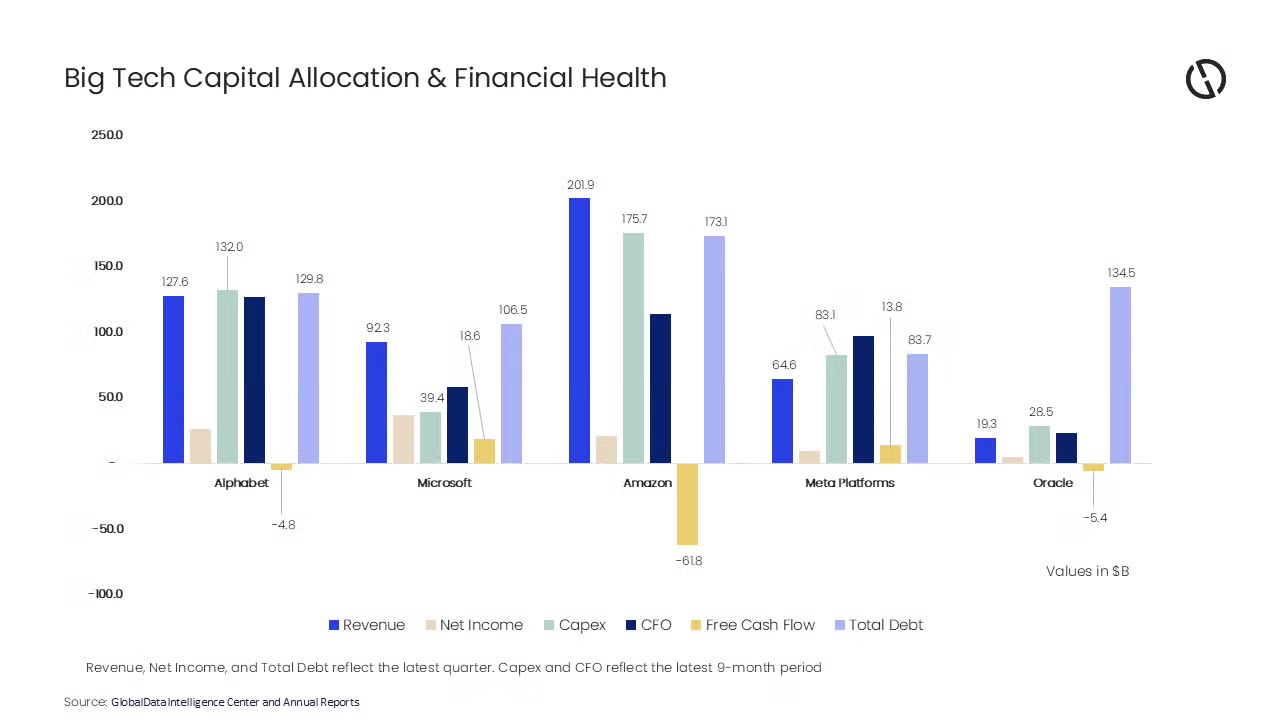
The quarterly financial results reveal this growing imbalance. Revenue growth remains healthy, but capital expenditure is expanding much faster, putting pressure on free cash flow (FCF).
Alphabet illustrates the pressure most clearly. Revenue rose 24.7% to $127.6 billion, while net income declined 24.3% to $26.5 billion. Capex surged 107.5% to $132 billion, exceeding CFO of $127.1 billion and pushing FCF into a $4.8 billion deficit from a $48.7 billion surplus a year earlier.
Amazon reported negative FCF of $61.8 billion as capex reached $175.7 billion, up 90.3%. Meta’s FCF declined 55.8% to $13.8 billion despite strong earnings growth. Microsoft remained cash-flow positive at $18.6 billion, although FCF declined 27.4%. Oracle recorded negative FCF of $5.4 billion following a 235.2% increase in capex.
Murthy Grandhi, Company Profiles Analyst at GlobalData, comments: “The financing challenge is becoming equally important. With internal cash generation increasingly insufficient to fund infrastructure expansion, the technology industry is turning towards corporate bonds, private credit, infrastructure funds and special-purpose vehicles (SPVs). Oracle’s financing strategy provides a concrete example: it raised $43 billion in debt during fiscal 2026 alongside $5 billion in equity financing.”
This creates a second financial burden beyond depreciation. Higher borrowing and refinancing costs could increase interest expenses, compress net income and weaken EPS, particularly if AI monetization disappoints. Companies may have to moderate dividends and share buybacks, preserve cash, restructure headcount and prioritize projects with demonstrable returns. Debt-financed expansion also introduces refinancing and balance-sheet risks if demand for computing capacity slows or technology becomes obsolete faster than expected.
Meanwhile, the race for superintelligence is intensifying. The US is supporting domestic AI infrastructure and technological leadership through government policy and strategic investment, while China is accelerating semiconductor self-reliance, domestic AI models and industrial applications. This competition is increasingly about controlling the entire ecosystem, from advanced chip manufacturing and high-bandwidth memory to cloud infrastructure and AI applications.
The semiconductor supply chain is also creating inflationary pressures. South Korea’s KOSPI plunged 7.57% on 15 October 2026, as Samsung Electronics and SK Hynix suffered sharp losses amid concerns over AI investment sustainability and persistent US inflation. Higher memory, server and energy costs could eventually feed into consumer electronics prices, adding to inflation and potentially delaying interest-rate cuts.
Grandhi concludes: “GlobalData sees 2027 could become a critical test of AI economics. Global equity markets may increasingly differentiate between companies generating measurable AI revenues and those relying on future expectations. Emerging markets could benefit through semiconductor manufacturing, memory exports, data centres and power infrastructure, but remain vulnerable to imported technology costs, capital outflows and inflationary pressures.
“The survival strategy is disciplined capital allocation. Companies must prioritize commercially viable AI applications, improve infrastructure utilisation, secure long-term customer commitments and demonstrate returns on invested capital. They must also maintain manageable leverage, protect core business profitability and preserve shareholder returns. The winners of this AI cycle will not necessarily be those spending the most, but those converting technological leadership into recurring revenues, sustainable earnings and durable free cash flow.”