

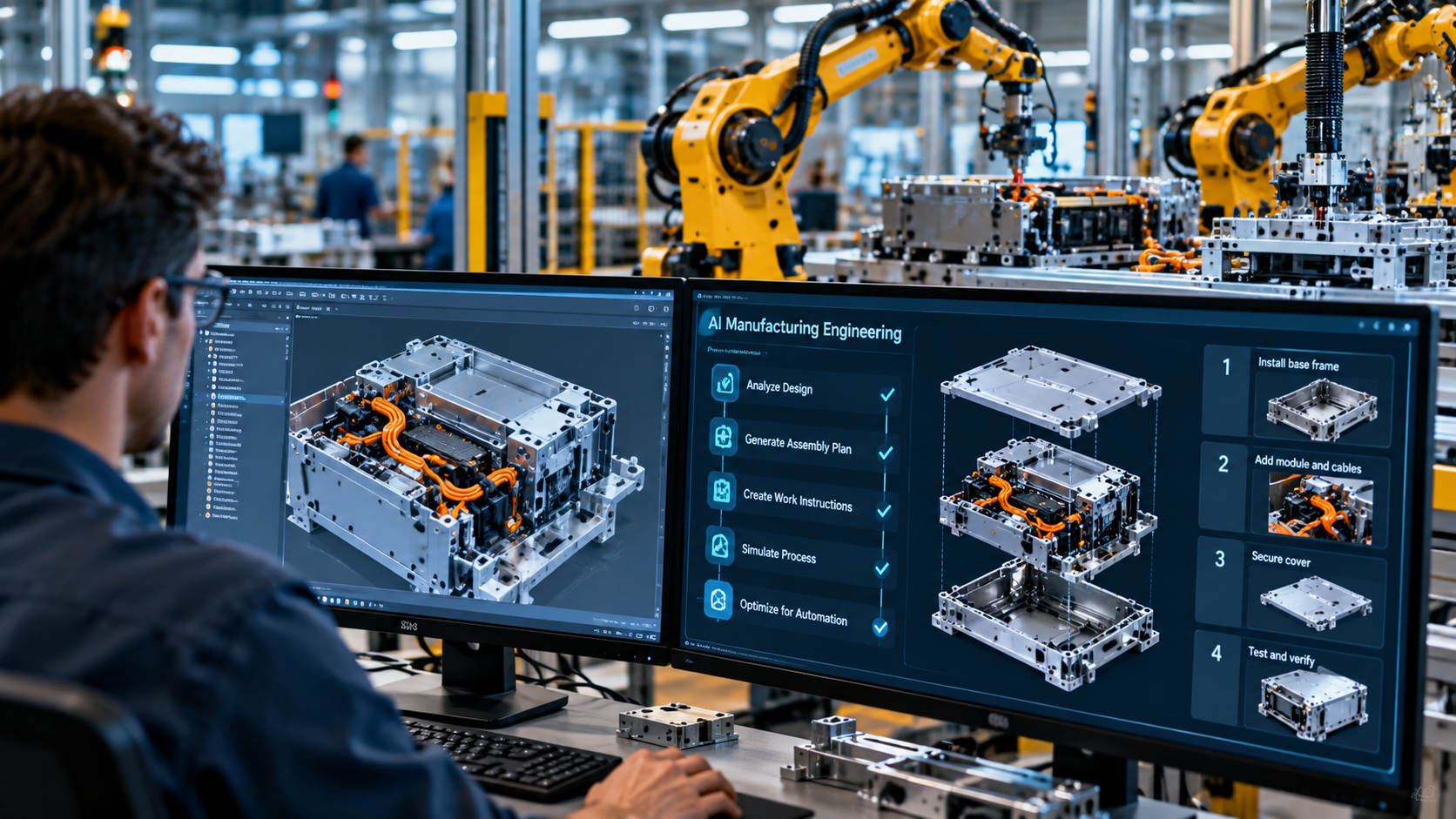
Arda Industries, founded by former OpenAI Chief Research Officer Bob McGrew, has emerged from stealth with $232 million in funding and a $1.5 billion valuation. The AI manufacturing startup is developing software to automate manufacturing engineering, generate assembly instructions and help factories adapt production lines to changing product designs.
Unlike industrial AI applications focused on predictive maintenance, quality inspection or production analytics, Arda is targeting manufacturing engineering. Its software uses AI agents to analyze computer-aided design (CAD) files and other product information to generate assembly plans and work instructions.
The objective is to reduce the engineering effort required to introduce new products and modify existing production processes.
Arda’s AI Manufacturing Software Is Already Deployed at Anduril Industries
Arda’s technology is already being used by defense technology manufacturer Anduril Industries as part of its ArsenalOS manufacturing software platform. Anduril was Arda’s first design partner and customer.
According to figures released by Arda, basic assembly instructions that previously required approximately 10 hours of engineering work can now be produced in 15 minutes. More complex engineering workflows that once required up to 30 hours reportedly take approximately 2.5 hours.
These performance figures were provided by the companies and have not been independently verified.
The potential benefits extend beyond labor savings. Faster preparation of manufacturing instructions could allow companies to introduce engineering changes more frequently while reducing delays between product design and production.
“Their designs change at software speed, but their factories don’t,” said Bob McGrew, founder and CEO of Arda.
McGrew said the company was created to address the widening gap between rapidly changing product designs and the manufacturing engineering required to produce them. Arda’s longer-term vision is to enable highly automated U.S. manufacturing with the flexibility associated with Shenzhen’s electronics manufacturing ecosystem.
Addressing the Challenge of Rapid Product Changes
Manufacturers of electronics, drones, defense equipment and other advanced products face increasingly short product development cycles. While designs can be revised quickly using modern engineering software, corresponding changes to factory equipment and assembly processes often require substantial engineering resources.
Conventional industrial automation can be particularly difficult to reconfigure. Programming and validating automated assembly stations for new products may take months, potentially making dedicated automation uneconomical for products with short production lifecycles.
Arda intends to address this mismatch by automating portions of the manufacturing engineering process.
The company is initially targeting defense manufacturing and suppliers to the data center industry, including manufacturers of transformers and electrical equipment. Consumer electronics represents a longer-term market.
AI-Powered Robotics Is Arda’s Next Development Stage
Arda’s longer-term plans extend beyond generating manufacturing documentation.
The company is developing AI agents capable of programming industrial robots to execute assembly plans. Its stated objective is to reduce the time needed to adapt automated production lines to changing product designs from months to days.
This capability remains under development. Arda has not announced a commercially available system capable of automatically reconfiguring complete robotic assembly lines.
If successfully implemented, the technology could reduce one of the major barriers to flexible automation: the engineering time and expense associated with reprogramming production equipment.
Arda Raises $232 Million from Major Technology Investors
Arda’s financing includes a $160 million Series A round co-led by Altimeter, Accel and Khosla Ventures, following a $72 million seed round led by Accel and Founders Fund.
McGrew previously led product and engineering operations at Palantir before joining OpenAI, where he led research activities from 2018 to 2024.
The company plans to use its financing to expand its engineering and research teams, increase customer deployments and develop AI models for robotic assembly.
What Arda Could Mean for the Future of Manufacturing
For manufacturing companies, Arda represents an emerging application of artificial intelligence: using AI not simply to monitor factory operations, but to automate the engineering work required to establish and modify production processes.
If the technology can deliver on its ambitions, it could help manufacturers respond faster to product changes and make flexible automation more practical across industries with demanding production requirements.
Source: Arda Industries company announcement, October 20, 2026.